














S_olar
E_clipse
A_rtists
R_esidency
2 - 16 AUG 2026
@ KULTURFABRIK SCHÖNBACH
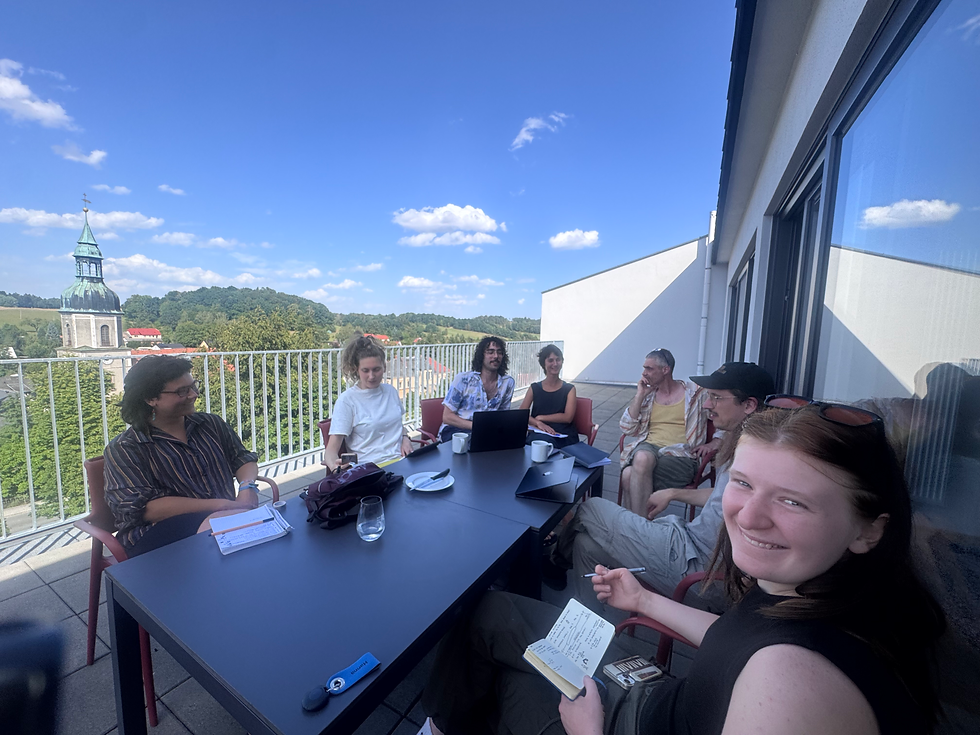
SEAR 2026 brought artists, scientists, and regional participants together in Upper Lusatia for two weeks of collective research, production, and exchange around the partial solar eclipse of 12 August 2026, which reached about 85 percent coverage over the region.
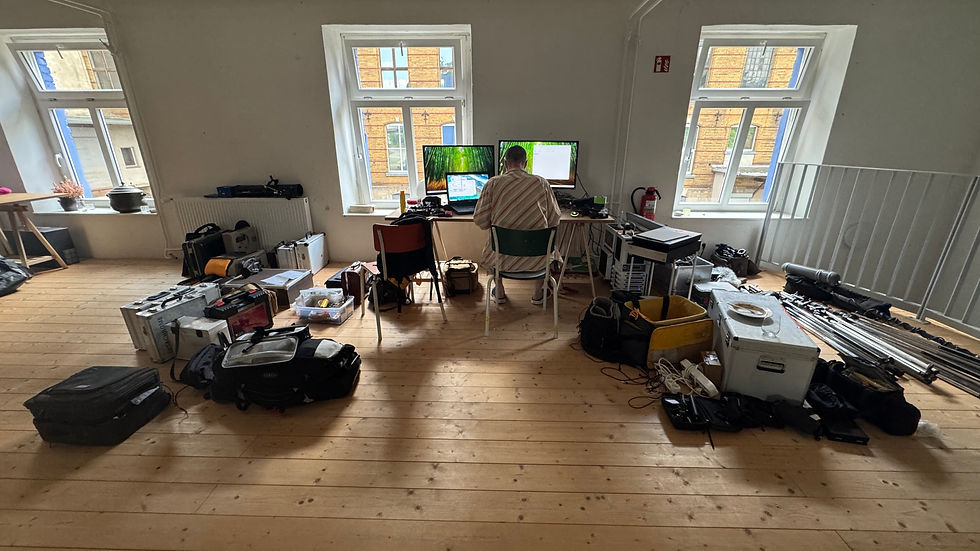
Based at Kulturfabrik Schönbach — an 1868 weaving mill, later a medical-gauze factory, set among Umgebinde houses, forests, and hills — the groups developed films, sound pieces, performances, mappings, and installations connecting astrophysics, Sorbian cosmologies, and regional histories with contemporary artistic practice.
The residency was shaped by its context: active and rewilded open-cast mines, the seismic quiet of the Lusatian granite as a candidate site for the Einstein Telescope, and Sorbian culture with its own language and landscape memory. The region was not a backdrop — it was subject and frame of the artistic research.
Six to eight multidisciplinary groups formed the core — artists in time-based media, scientists, and regional participants.
Each group turned its exchange into independent works, in which scientific data, models, and instruments were not illustrated but became artistic material. The participating research institutions are therefore credited as co-authors.
The process moved on three levels: a preparatory online research phase; fieldwork and production on site; and the public Eclipse Field Day, followed by post-production.
HOW
WE
WORK
THE
MES
The eclipse served not only as occasion but as a methodological figure: it stands for observation, concealment, and the question of what becomes visible precisely when something else is hidden — the movement connecting the residency's film-, sound-, data-, and performance-based works.
One thread ran through several projects: from loom to algorithm — the region's textile history, where the Jacquard loom's binary punch cards mark an early link between material, structure, and computational thinking.
Around a dozen independent works came out of the residency: film, video and VR installation, sound works, photography, and experimental prints.
Some turned measurement and noise — gravitational-wave data, seismic readings, simulations — into image and sound. Others read the landscape itself: post-mining ground, Sorbian toponyms, the textile past, the eclipse as a figure for memory, transformation, and recurrence.
Filmed as a single continuous take, the public Eclipse Field Day became the documentary film TSHBE!
The works from SEAR 2026 came together in the group exhibition The Sun Has Been Eaten! – The Observer Effect at Kunsthalle Görlitz, 18 September – 3 October 2026. → see the exhibition
WHAT EMER
GED
PROGRAM
Pre-phase · starting July.
The work began online — in video calls per group, participants met their shared theme and gathered first associations, arriving in Schönbach with a common focus and first hypotheses in hand.
WEEK 1 FROM 2 – 7 AUGUST.
research, workshops & first production.
The first days were for arriving, forming groups, and sharpening questions. Alongside the project work ran open sessions and talks:
Monday 3 August.
Image and glitch w/ ROSA MENKMAN.
Menkman gave glitch art its vocabulary. Her Glitch Studies Manifesto reads the break in the flow as the moment a technology stops hiding and shows what it actually is. Her later work shifted from glitch to resolution — the more political question: setting a standard promotes order and efficiency and, in the same move, buries the alternatives that were never allowed to exist. She founded the institutions for Resolution Disputes (TRANSFER Gallery, New York), wrote The Glitch Moment(um) and Beyond Resolution, and won CERN's Collide International Barcelona Award, which sent her research toward what makes images im/possible. Since 2023 she runs the Im/Possible Lab at HEAD Genève. For a residency built on what an eclipse makes visible by hiding it, the sharpest possible opening — a talk on visible/invisible, glitch and ghosts, opening into shared questions. Find out more: beyondresolution.info
Monday 3 August.
Information Field Theory
w/ PD DR. TORSTEN ENßLIN (DZA / MPA Garching).
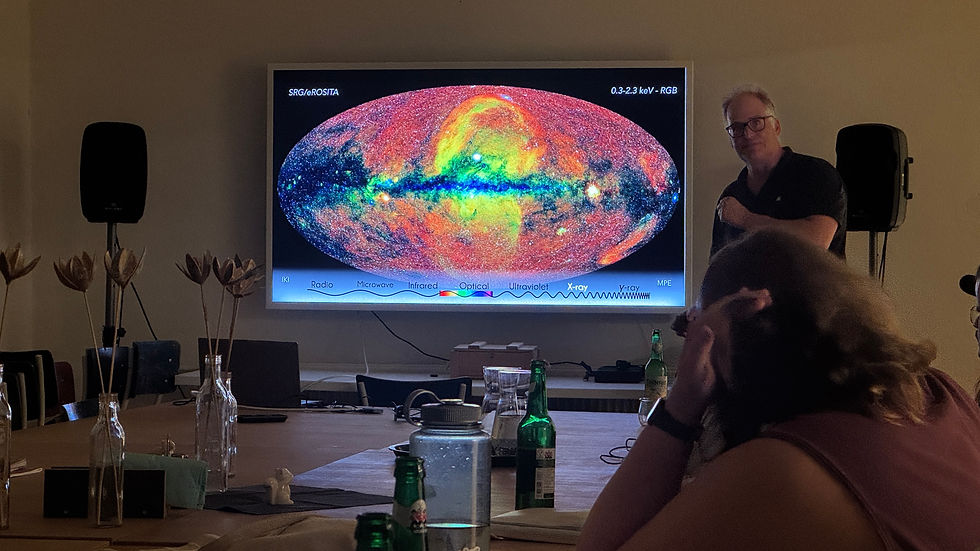
An evening talk on reconstructing signals and images from noisy, incomplete data, and on Enßlin's work on artificial intelligence and the manipulative communication of machines — whose simulations of communicating agents generated the text of the work The Observer Effect. The same evening opened with short introductions from Dr. Sylvia J. Zhu (DESY) and Dr. Konstancja Satalecka (DZA).
Find out more: https://wwwmpa.mpa-garching.mpg.de/~ensslin/
Tuesday 4 August,
Jama: přichod [pit: future] sorbian/wendish realities and visions for futures,
w/ KAROLINE SCHNEIDER / KRAWC.
An introduction to the Sorbian world, focused on mythology, cosmogony, and the sun. Karoline was born in Bautzen, is Sorbian, and lives in Leipzig. Her work develops serbski futurizm — a Sorbian futurism oriented on critical futurisms like Afrofuturism rather than on preservation, asking what a minority looks like in its own future instead of only in its own past. Installation, video, ceramics, augmented reality; her solo show jama: pśichod / Grube: Zukunft ran at the BLMK Cottbus in 2026. Her artistic PhD examines cowrie shells on the harnesses of Sorbian Easter riders — a shell from the Indian Ocean on a horse in Lusatia, and the trade routes that put it there. Find out more: karolineschneider.me
Wednesday 5 August, Introduction to the CASUS research fields.
The CASUS researchers introduced their fields and the work of the centre: Dr. Rainer Wunderlich, Dr. Eduardo H. Colombo, Dr. Ismail Ismail and Lagan Dhanda on the theory of complex systems, with Philipp von Haymerle on the work of CASUS.
Thursday 6 August.
TouchDesigner
w/ LYNN MAYYA.
Lynn is a Syrian-born audiovisual artist based in Berlin, working at the NODE Institute — the TouchDesigner and VVVV hub. She studied Time Based and Interactive Media Art in Linz and performs generative real-time work, building environments where image and sound are made in the moment rather than played back. Her day came in two halves: the basics in the morning, from nothing; an open surgery in the afternoon for those already working in it. With several projects here leaning on real-time image systems, the practical spine of the first week. Find out more: lynnmayya.com
Thursday 6 August.
Ecological filmmaking with AI —
w/ FLORENT PALLARES & THOMAS VIVIEN from Film Spring Open France.
An introduction to ecologically oriented filmmaking with AI, led with Thomas Vivien — the content seed of the later German–Polish–French collaboration in the Film Spring Open network. Both work within FSO's interdisciplinary European education programmes, run under cinematographer Sławomir Idziak (Three Colours: Blue, Gattaca, Black Hawk Down, Harry Potter and the Order of the Phoenix). Their strand pairs AI applied to audiovisual production with more ecological ways of working, taught through the Cinébus — a mobile, low-energy training studio that runs practical courses in Poland and France. The best participants from those courses are invited to the Film Spring Open Workshops in Kraków (13–22 October 2026), the network's large international lab. Find out more: filmspringopen.eu
Friday 7 August.
On Ancestral Technologies,
w/ TABITA REZAIRE, online from Guyane.
Rezaire lives in Cayenne, French Guiana, and works where technology, spirituality, ancestral knowledge, and cosmology meet — with no hierarchy between them. She tends Amakaba, a sacred forest in the Amazon organised around a garden of medicines, birthwork on the land, and collective starwork: a portable planetarium that remembers an astronomy older than the one we were taught. In 2026 she was part of In Minor Keys, the main exhibition of the 61st Venice Biennale. Given two weeks spent pointing instruments at a sun about to be covered, a practice that keeps a planetarium for an older astronomy was not decoration on the programme — it was a second way of asking the same question. Online from Guyane, Find out more: tabitarezaire.com
OUR SCIENTIFIC GUESTS
FROM DZA, DESY & CASUS
The groups work alongside researchers connected to Lusatia and its emerging research landscape:
Deutsches Zentrum für Astrophysik (DZA)/
Deutsches Elektronen-Synchrotron DESY & TU Dresden
DR. KONSTANCJA SATALECKA
Multi-messenger astronomy — MAGIC, IceCube, CTA — and regional science communication.
DR. MIKE LINDNER
Geophysics and seismology; the Low Seismic Lab and Lusatia's seismic quiet.
PD DR. TORSTEN ENßLIN, MPA Garching and DZA
Information field theory, artificial and natural intelligence. His simulations of communicating agents, which produce self-deception and machine gossip, generate the text of one of the films made here.
DR. SYLVIA J. ZHU, DESY Zeuthen
Gamma-ray bursts, supernovae, and gravitational-wave sources; data sonification with artists.
JOHANNES WÜNSCHE (JAN WINŠA), TU Dresden · Einstein Telescope
Doctoral researcher in elementary-particle phenomenology at the Institut für Kern- und Teilchenphysik (IKTP), TU Dresden; interviewed in Sorbian for Katja Hrjehorjec's work.
Center for Advanced Systems Understanding (CASUS),
an institute of Helmholtz-Zentrum Dresden-Rossendorf (HZDR)
DR. EDUARDO H. COLOMBO
Complex systems, theoretical ecology, and pattern formation — landscape heterogeneity as a lens that reveals the hidden.
DR. RAINER WUNDERLICH
Complex systems; macroecology and species-distribution modelling.
DR. ISMAIL ISMAIL
Theory of complex systems, Görlitz.
LAGAN DHANDA
Theory of complex systems, Görlitz.
DR. JIŘÍ VYSKOČIL, formerly CASUS
Physicist specialising in high-performance computing, simulation, and scientific visualisation — and an artist in his own right, resident for the full two weeks with his own project on cosmic structures.
WEEK 2 FROM 9 – 16 AUGUST.
field works, production, eclipse & premieres.
The second week shifted fully into making: filming, recording, building, cutting, paced toward 12 August, when the partial eclipse became both a shared event and a source of material. Shoots and excursions ran across the region — the open-cast landscapes near Jänschwalde and Turnow, an exploratory borehole for the Einstein Telescope, the Berzdorfer See, the Kühlhaus Görlitz. On 15 August the residency closed internally, the groups showing each other where the work had got to.
WED 12 AUGUST.
TSHBE! — THE SUN HAS BEEN EATEN!
19:18 first contact · 20:10 maximum, ~85 % · 20:29 the sun sets, still covered
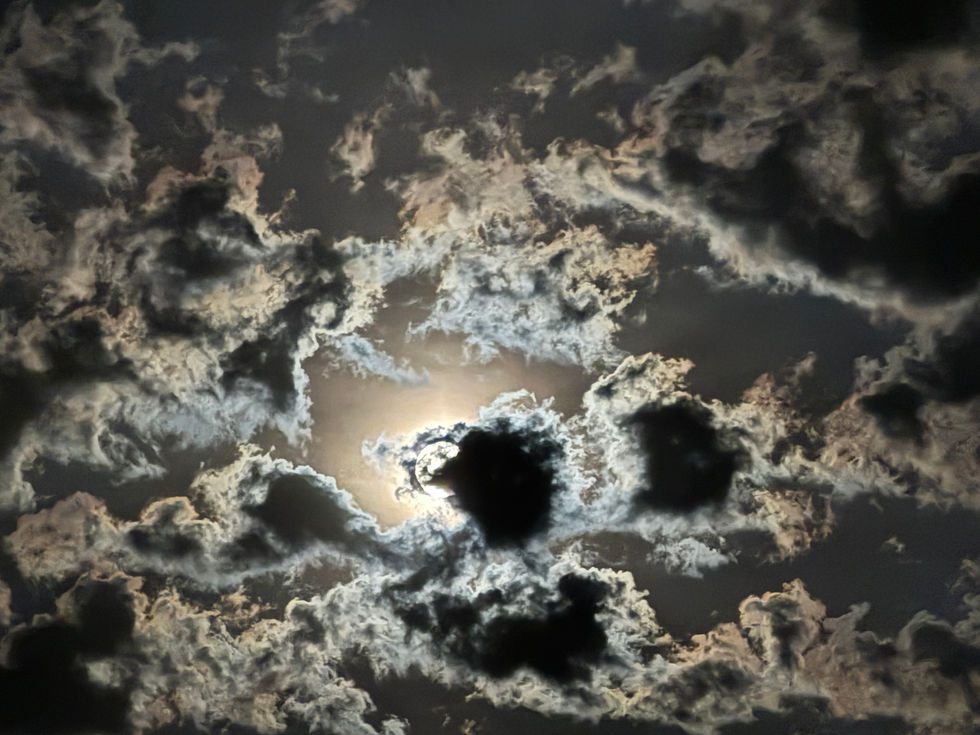
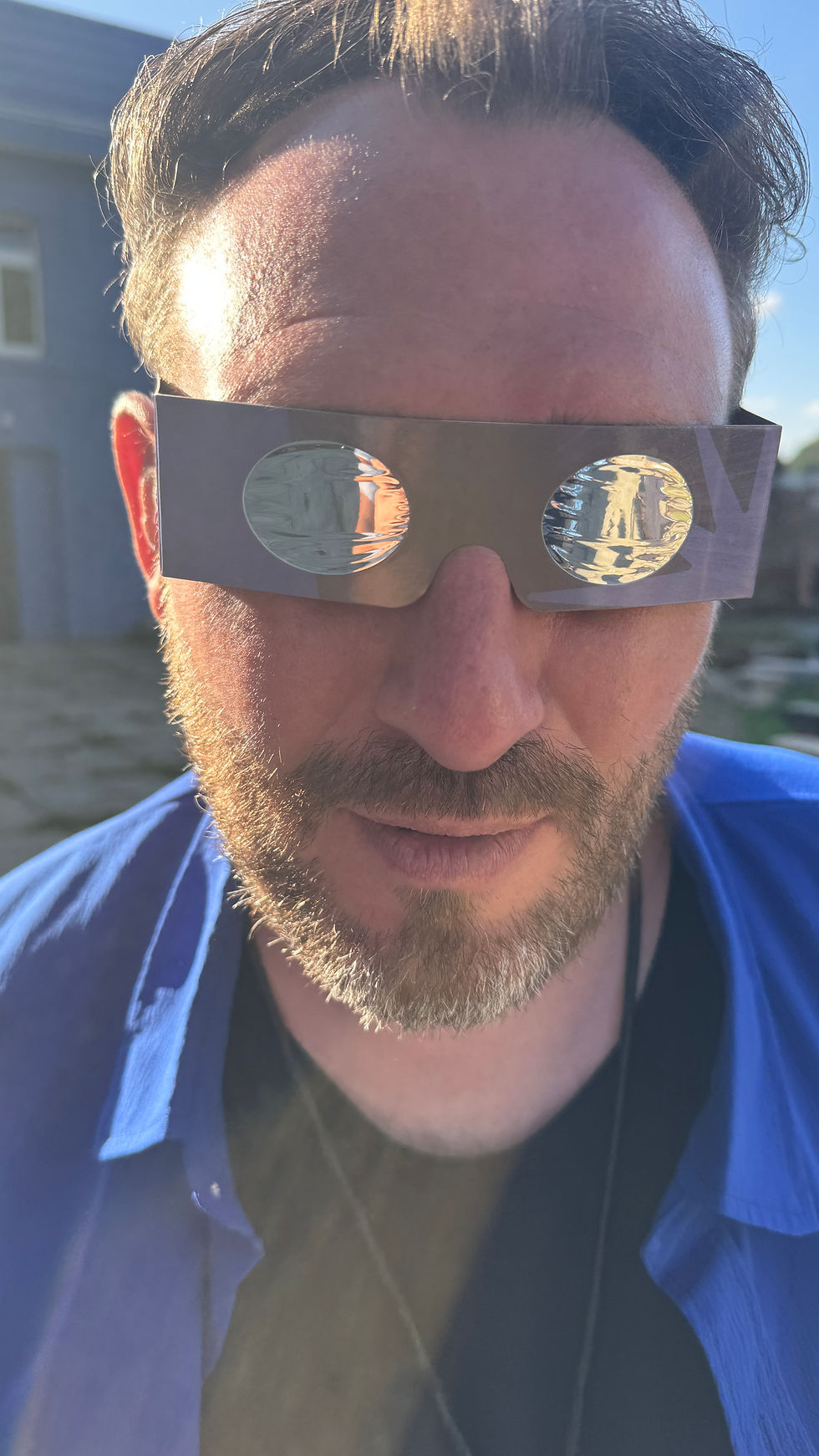
Never night, but that wrong, tilted light where the colours go metallic, birds fall quiet, and insects start up as if someone had tampered with the clock. Not a viewing appointment but a day you walked through: from a flooded granite quarry, up through forest, across open slope, onto a mountain, and into the night.
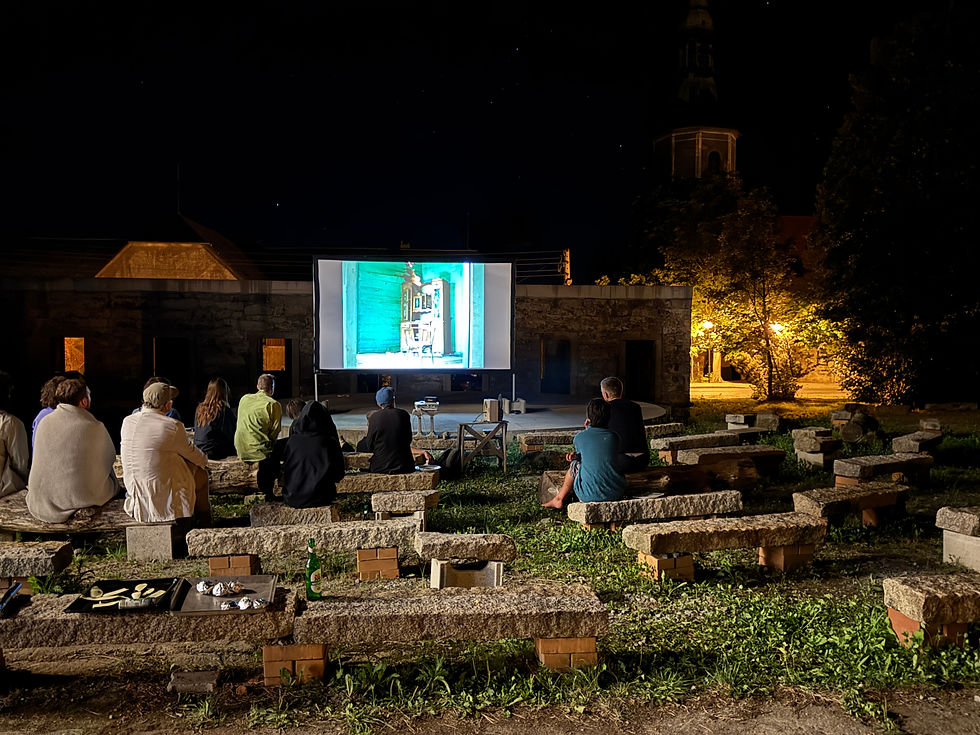
Five stations, each named for a term from physics or cosmology, strung along one continuous path and filmed as a single unbroken take — sound, performance, and the sky itself folded into one movement. Free, public from the gathering point onwards. Dress code red. → find out more.
What else is SEAR?
Autumn & Winter 2026.
Once the eclipse phase was over, the focus turned to finishing and putting the work into the world: editing, sound design, and colour were completed, multichannel installations and performative formats tested, and the groups exchanged strategies for presentation and distribution. First public presentations began on 22 August — at the CASUS FOKUS Festival in Görlitz, alongside the CASUS Open Door Day. From there the work carried onward into the exhibition at Kunsthalle Görlitz (18 September – 3 October) and further festivals and science–art contexts, shown together with the scientists and communities involved.
DONORS
We’d like to express our sincere thanks to our supporters and sponsors. Their commitment is essential to making our projects possible


Das Vorhaben wird gefördert durch die Stiftung für das sorbische Volk, die jährlich auf der Grundlage der beschlossenen Haushalte des Deutschen Bundestages, des Landtages Brandenburg und des Sächsischen Landtages Zuwendungen aus Steuermitteln erhält.
Projekt spěchuje so wot Załožby za serbski lud, kotraž dóstawa lětnje přiražki z dawkowychsrědkow na zakładźe hospodarskich planow, wobzamknjenych wot Zwjazkoweho sejma, Krajneho sejma Braniborskeje a Sakskeho krajneho sejma.
Projekt spěchujo se wót Załožby za serbski lud, kótaraž dostawa lětnje pódpěru z dankowychsrědkow na zakłaźe etatow, wobzamknjonych wót Zwězkowego sejma, Krajnego sejmaBramborska a Sakskego krajnego sejma.
PARTNER
Our heartfelt thanks go to our partner, whose shared vision and aid
help us create spaces for imagination, dialogue, and film.


SEAR
is part of a growing network of independent residencies,
research labs, and community-based initiatives working across art, science, and regional contexts.
Together with partners such as FSO Poland & FSO France and other international collaborators, we are building connections that extend beyond a single residency format — creating shared structures for production, exchange, and presentation across borders.
This means that projects developed within SEAR do not end in Schönbach. They continue to move: into presentations in Upper and Lower Lusatia, into partner institutions, festivals, and exhibitions, and into further collaborative formats.
At the same time, SEAR remains rooted in its local context. The work is shaped by the specific conditions of Lusatia — its landscapes, histories, communities, and ongoing transformations — and grows outward from there.
The aim is to create a space where projects can evolve over time: through follow-up invitations, continued collaborations, and the possibility to return, expand, or reconfigure what has been started here.
THE UNIVERSE IS SPEAKING IN NUMBERS
69
WORKS
Essay, film, sound, installation, performance & beyond.
180+
ARTISTIC CONTRIBUTORS
Tutors, mentors, filmmakers,
artists, thinkers, performers.
110
PARTICIPANTS
Emerging artists, filmmakers and scientists from many fields
30+
COUNTRIES AND REGIONS
People from the Sorbian Triangle
to Sri Lanka and beyond
1200+
AUDIENCE MEMBERS
Across screenings, lectures,
exhibitions & concerts.
25+
PARTNERS AND SUPPORTER
from Lusatia, the Euroregion Neisse and international
200k+
EURO
invested directly into the region through cultural & educational programmes
13
6 EDITIONS AND 7 EVENTS
next: FSO Germany May 2027@ Kühlhaus Görlitz


